Showing posts with label Book Review/Summary. Show all posts

Sunday, March 17, 2019

Book Review/Summary - How the Irish Saved Civilization (Thomas Cahill)


While not a book about theology, it is a really interesting part of church history. The Germanic people who had adapted the Roman agriculture had a population explosion because of it. In 406, they crossed the Danube and the Rhine into Rome for the first time and 476 saw the death of the last Roman Emprorer and the fall of the Roman Empire. Cahill then states that Augustine is the "last classical man" and the first "Medieval man". After the fifth century, the law was mostly carried out by the church. Meanwhile during all this time, the dominant culture in Ireland was the Spanish Celts, who entered in the 4th century BC and were an illiterate, semi-nomadic, Iron Age warrior culture, that advanced little. Their economy was based on property such as animals and slaves. Patrick was  a Roman Briton taken to Ireland as a slave at the age of about 15, in 400. He escaped 7 years later and returned 25 years after that to be a missionary for the last 30 years of his life.

The Irish, whose culture was big on sacrifices, adopted "green martyrdom", which was moving to remote locations and subsistence living, while devoting oneself to learning and to God. This quickly led to the monastic tradition. They brought in and copied as many books as they could, learning all they could, amassing vast libraries (the largest in the world). The burning of the Library in Alexandria, was really a series of destruction from an attack by Aurelian in 270s, the decree of Coptic Pope Theophilus in 391, ten years after the First Council of Constantinople, and the decree of the second caliph Omar ibn Al-khattab in 640.


The Rise and Fall of Rome

Sunday, November 18, 2018

Book Review/Summary - Ordering Our Days in His Peace (Heath Curtis)


This is a great book about the Church year!
  • God made everything for the good of humanity.
  • God made time.
  • Time is for the good of humanity because it helps us make sense of and order God's creation.
  • The Gospel is a story that takes place through time.
  • The Church uses the church year calendar to keep time and tell the Gospel.
  • Each part of the church year has something new to give us and a piece of the story to tell.
    • The time of Christmas is about our Savior being promised and finally coming
    • The time of Easter is the fulfillment of the Savior's work
    • The time of the Church is about God working through the Church after the Savior comes
  • God works through the church by the means of the Word and Sacraments.
  • The Church year and Gospel are ordered through the Divine Service.
  • The Divine service is ordered to give us all of the gifts God wants to give us (the Word and Sacraments)

Wednesday, April 13, 2016

Spying in the Bible - References

I realized that it would be good to have a bibliography for the resources that I used in making the series:

Alvarez, David. Spies in the Vatican: Espionage and Intrigue from Napoleon to the Holocaust. Lawrence: University Press of Kansas, 2002.
Austin, N. J. E. and N.B. Rankov. Exploratio: Military & Political Intelligence in the Roman World from the Second Punic War to the Battle of Adrianople. London: Routledge, Taylor, and Francis Group, 1998.
Bright, John. A History of Israel, Fourth Edition. Philadelphia: Westminster John Knox Press, 2000.
Cardwell, John M. “A Bible Lesson on Spying.” Studies in Intelligence, Volume 22, Number 4 (Winter 1978): 59-63 (declassified).
Clark, Robert M. “Scientific and Technical Intelligence.” Studies in Intelligence, Volume 19, Number 1 (Spring 1975): 46-47 (declassified).
Clayton, Peter A. Chronicle of the Pharaohs: The Reign-By-Reign Record of the Rulers and Dynasties of Ancient Egypt. London: Thames & Hudson Books, 2006.
Crowdy, Terry. The Enemy Within: A History of Spies, Spymasters, and Espionage. New York: Osprey Publishing, 2006.
Dulles, Allen W. The Craft of Intelligence: America’s Legendary Spy Master on the Fundamentals of Intelligence Gathering for a Free World. New York: Harper & Row, 1963.
Engelbrecht, Edward A. (Editor). The Apocrypha: The Lutheran Edition with Notes. St. Louis: Concordia Publishing House, 2012.
Engelbrecht, Edward A. (Editor). The Lutheran Study Bible: English Standard Version. St. Louis: Concordia Publishing House, 2009.
Frattini, Eric and Dick Cluster (translator). The Entity: Five Centuries of Secret Vatican Espionage. New York: St. Martin’s Press, 2008.
Free, Joseph P. Archeology and Bible History, Revised Edition. Grand Rapids: Zondervan, 1992.
Gill, John. John Gill’s Exposition of the Entire Bible. Grand Rapids: Baker Books, 1982.
Herzog, Chaim and Mordechai Gichon. Battles of the Bible: A Military History of Ancient Israel. Barnsley: Greenhill Books, 1997.
Heuer, Richards J. Jr. Psychology of Intelligence Analysis. Center for the Study of Intelligence, Central Intelligence Agency, 1999.
Hoerber, Robert G, editor. Concordia Self Study Bible: New International Version. St. Louis: Concordia Publishing House, 1986.
Josephus, Flavius. “The Antiquities of the Jews”, in The New Complete Works of Josephus. Translated by William Whiston. Commentary by Paul L. Maier. Grand Rapids: Kregel Publications, 1999.
Liulevicius, Vejas Gabriel. Espionage and Covert Operations: A Global History. Lecture from The Great Courses Website, http://www.thegreatcourses.com/tgc/courses/course_detail.aspx?cid=8922
Magness, Jodi, Holy Land Revealed. Lecture from The Great Courses Website, http://www.thegreatcourses.com/tgc/courses/course_detail.aspx?cid=6220
Sapp, Edwin C. “Decision Trees.” Studies in Intelligence, Volume 18, Number 4 (Winter 1974): 45-57                           (declassified).
Schulz, Klaus Detlev, Robert G. Clouse, and Marianka S. Fousek. The Church from Age to Age: From Galilee to Global Christianity. St. Louis: Concordia Publishing House, 2011.
Sheldon, Rose Mary. Espionage in the Ancient World: An Annotated Bibliography of Books and Articles in Western Languages. Jefferson: McFarland and Company, 2002.
Sheldon, Rose Mary. Spies of the Bible: Espionage in Israel from the Exodus to the Bar Kokhba Revolt. St. Paul: MBI Publishing, 2007.
Steinmann, Andrew E. From Abraham to Paul: A Biblical Chronology. St. Louis: Concordia Publishing House, 2011.
Volkman, Ernest. The History of Espionage: The Clandestine World of Surveillance, Spying and Intelligence, from Ancient Times to the Post-9/11 World. Glasgow: Carlton Books, 2007.

Saturday, January 2, 2016

Spying in The Bible - Introduction


Over the years I have noticed how much espionage is in the Bible. I looked for a good book on the subject, but there just isn't one.  The only book remotely touches on the subject that I have found is Rose Mary Sheldon's book "Spies of the Bible." However, Sheldon barely scratches the surface of espionage in the Bible, and instead uses her book to push her agenda of modern Biblical criticism. Also, she has a background in history, not espionage, so she is not a subject matter expert. The book is inaccurate and misleading and only has a little general military analysis information in it as a thin veil to justify the title of the book.

So, for the next little while my blog posts will go through the whole Bible/human history and tell the story through looking at the cases of espionage. I have been working on this off and on for about last five years now and think I will be able to cover most of it.

Friday, December 18, 2015

Book Review/Summary - Miracles (C.S. Lewis)


I have always really appreciated C.S. Lewis' definition of miracles. Miracles are events that would not normal have happened in the physical, material world, but once they do, the rest of what happens do follow the normal laws of nature.

He also dispels some common arguments against miracles. The first, and best in my opinion, is that the modern mind is so much more advanced than the "primitive" mind. However, it was clear that Joseph knew Mary's virgin pregnancy did not follow the laws of nature, as has everyone else, even in the "primitive" world. When he found out she was pregnant, he thought she was unfaithful and had in mind to divorce her quietly. The second objection he tries to dispel is that of life on other planets. I have a previous post about this theme in his works here.

A list of Jesus' miracles is in a previous post here.

Thursday, November 19, 2015

Unity


I have written about unity being in a shared (correct) doctrine in previous posts, but I wanted to explore what theologians throughout church history have taught.

Starting with the church fathers, St. Cyprian wrote "The Unity of the Church", his greatest work, to counter the Novatian schism. In it, he argues that there can only be one united church:
"The spouse of Christ cannot commit adultery. She is uncorrupted and pure. She knows one home, she guards with chaste modesty the sanctity of one bed. She keeps us for God. She appoints the sons whom she has born for the kingdom. Whoever is separated from the Church and unites with an adulteress, is separated from the promises of the Church. No one who forsakes the Church of Christ can receive the rewards of Christ. He is a stranger; he is profane; he is an enemy. No one can have God for his Father, who does not have the Church for his mother....

"This sacrament of unity, this unbreakable bond of concord, is demonstrated in the Gospel, when the coat of the Lord Jesus Christ is not at all divided nor cut, but is received as a whole garment by those who cast lots for it. Scripture says, “Because the coat was seamless, woven in one piece from top to bottom, they said, ‘Let us not tear it, but cast lots for it.” [John 21:23-24] That coat had a unity from the top down, that is, unity that came from heaven and the Father, that could not be torn by those who received and possessed it. It is whole and undivided. No one who splits and divides the Church of Christ can possess the garment of Christ."

St. Ignatius of Antioch, in his Letter to the Philadelphians, 4,1 (ANF, Vol. I), wrote:
"Wherefore I write boldly to your love, which is worthy of God, and exhort you to have but one faith, and one [kind of] preaching, and one Eucharist. For there is one flesh of the Lord Jesus Christ; and His blood which was shed for us is one; one loaf also is broken to all [the communicants], and one cup is distributed among them all: there is but one altar for the whole Church, and one bishop, with the presbytery and deacons, my fellow-servants. Since, also, there is but one unbegotten Being, God, even the Father; and one only-begotten Son, God, the Word and man; and one Comforter, the Spirit of truth; and also one preaching, and one faith, and one baptism; and one Church which the holy apostles established from one end of the earth to the other by the blood of Christ, and by their own sweat and toil; it behooves you also, therefore, as "a peculiar people, and a holy nation," to perform all things with harmony in Christ."

Later, during the reformation, Martin Luther (sermons from the year 1531, W.A 34-11-387. "Day by Day We Magnify Thee" p. 384) wrote:
"No, my dear man, do not recommend to me peace and unity when thereby God's Word is lost, for then eternal life and everything else will be lost. There can be no yielding nor giving way, no, not for love of you or any other person, but everything must yield to the Word, whether it be friend or foe. The Word and doctrine will create Christian unity or fellowship. Where they reign all else will follow. Where they are not, no concord will ever abide. Therefore do not talk to me about love and friendship, if that means breaking with the Word, or the faith, for the Gospel does not say love brings eternal life, God's grace, and all heavenly treasures, but the Word."

Also:

The founder of the American, Lutheran Church, Missouri Synod, CFW Walther, in his "Pastoral Theology", wrote:
"Sadly, as we have discovered, there are many preachers who call themselves Lutheran and, after preparing the holy table to administer the Lord’s Supper, invite to the gift of grace anyone who wants to come—without permitting an examination their faith and life. And they even think this is a most Gospel-centered practice."

J.W. Baier explains:
“[T]he unity of the Church is disturbed by syncretism, or the religious union of dissenting parties in a brotherly and ecclesiastical fellowship in spite of dissension, so that either the errors in doctrine on the part of the dissentients or at least the erring persons themselves are tolerated within the communion of the Church and the latter are regarded as brethren in Christ and coheirs of eternal life. Either class of tolerance, however, is sinful.”

Wednesday, October 21, 2015

C.S. Lewis and Other Worlds


Rereading so much of C.S. Lewis' writings recently, I noticed a particular theme of "other worlds" starting to emerge. This hobby of his created some of his best (and best loved) works, but also brought him close to dangerous theology. The obvious one is, of course, Narnia in the Chronicles of Narnia fantasy series. However, one series (especially a fantasy one) does not make a theme, however, this topic comes up numerous times in both his fiction and nonfiction writings.

For example, in his essay, "Horrid Red Things," Lewis discusses how the language of heaven being "up" and hell being "down" is anthropomorphizing and perhaps using philosophical or scientific language might be a different way of thinking about Christianity. Maybe we could discuss Christ coming into the world from and leaving the world to another dimension. He concluded in the end to stick with historic language for consistency, but in my mind this thought has peril in that things like "dimensions" have definition in science and philosophy that are not Biblical.

The next series that has this theme is the science fiction "Space Trilogy." The main point of these books is that the other planets in the solar system are habited and some are unfallen. Lewis brings this up again in his book on Miracles. He states that the universe may be filled with unfallen creatures on unfallen worlds, that never needed redemption. The important ramifications of this is that in this view is that the fall into sin by Adam and Eve did not effect the whole universe, which is contrary to scripture. First of all, the Bible states that all of creation fell in Romans 8:22. Secondly, Lewis' view of the 6 day creation is suspect and in his book the Problem of Pain, he states that he does not necessarily agree that humans were created on the sixth day and are the crowning achievement of God's creative work.

Thursday, September 10, 2015

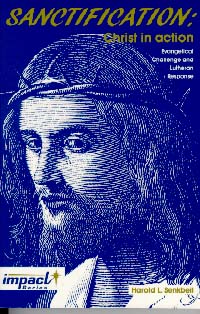
Book Review/Summary - Sanctification (Harold Senkbeil)


This book was good, but was more about the American Evangelical movement than sanctification as a theological topic.

One major topic was the confusion between the left and the right hand kingdoms. Senkbeil states, "Whenever the church has allied itself too closely with the cultural establishment, it has become corrupt and its Gospel has been secularized." He then points out that

  1. Liberals try to make the secular sacred by adopting societal ethics and norms
  2. Evangelicals try to makes the sacred secular by promoting "Christian" music, books, money management, etc..

Modern Evangelicalism is not really a theological system, but more of a mood, a perspective, and an experience. It focuses on a personal decision in conversion, while putting a spotlight on human experience instead of God's action.  However, the link between God and believer should never be our feelings but the person and work of Jesus Christ, who comes to us in his Gospel, not in our hearts. They teach that the wrath of God poured out on Jesus, so we receive God's Mercy, but then Grace comes from the individuals sanctified will and works. Thus we are partly forgiven because of our decision. Evangelicalism is:

  1. more form than substance
  2. more style than content
  3. more mind-set than dogma
  4. teaching replaced by lifestyle

It also picked the "selfish" or individualistic pieces of different traditions:

  1. Calvinism: individualism, but destiny
  2. Revival Arminisanism: Free Will in Conversion
  3. European pietist: spirituality and obedience
  4. Modernists: Focus on human achievement. more interested in that than Gods salvation

Most of their teaching revolves around "sanctification" as they call it, which is really "Christian" self help, a practical/pragmatic religion. In this system of thought Biblical figures, including Christ, become examples for us, instead of the story of how God saves us.

Tuesday, September 1, 2015

It's Bigger on the Inside


G.K. Chesterton (29 May 1874 – 14 June 1936) was a prolific English, Roman Catholic writer and Christian apologist.  Chesterton's 1925 The Everlasting Man was a sort of rebuttal to a sort of rebuttal to H.G. Wells’ 1920 Outline of History. The The Everlasting Man contributed to C. S. Lewis's conversion to Christianity. In a letter to Sheldon Vanauken (14 December 1950) Lewis calls the book "the best popular apologetic I know",  and to Rhonda Bodle he wrote (31 December 1947)  "the [very] best popular defence of the full Christian position I know is GK Chesterton's The Everlasting Man". The book was also cited in a list of 10 books that "most shaped his vocational attitude and philosophy of life". It also influenced Lewis to write apologetically, as in Mere Christianity. In fact, many of Lewis' motifs are derived from English authors who had just preceded him, such as the spacecraft in his 1938 Out Of The Silent Planet being losely modeled on the one in H.G. Wells' 1901, The First Men In The Moon.


In 1927, five years after his conversion, Chesterton wrote The Catholic Church and Conversion. Lewis could relate to this having been a convert himself. In this book, he states that a convert, upon discovering that the Catholic Church “finds that the Church is much larger inside than it is outside.” It logically follows that C.S. Lewis could have taken this for inspiration in his later book. Lewis completed the last ‘Narnia’ story, The Last Battle, in 1953, in which we see the end of the world of Narnia. At one point in the story the children find themselves in a stable. Seen from the outside it looked small and dingy, but when they go through the door they find themselves in a beautiful country that seems to stretch on forever. Someone comments that the stable is bigger on the inside than it is on the outside. The reply in the book is, “Yes,” said Queen Lucy. “In our world too, a Stable once had something inside it that was bigger than our whole world.”

Lewis’ stable is also connected with a kind of time travel, as it brought characters from the Narnia’s ancient past (indeed Digory watched its first dawn) into its last days. It is conceivable that Lewis' time traveling stable that is bigger on the inside could have been the inspiration for the time traveling Police box in Doctor Who known as the TARDIS. The Last Battle was a recent book when the TARDIS was first shown in Doctor Who in 1963. Lewis died the day before the first episode was shown, so he never got to comment.

Wednesday, August 12, 2015

Book Review/Summary - Not a Tame God: Christ in the Writings of C.S. Lewis (Steven P. Mueller)


Steven Mueller does a very thorough job of going through all of the C.S. Lewis' writings and examining his discussion and view of Christ and Christology. Overall the book is a little tedious and dry to read straight through, but it does have a ton of information. There are some inconsistencies that are pointed out, such as when Lewis many times claims to not like different theories of the atonement, but then uses them and even comes up with own. There are also times when Lewis' language is imprecise and misread as unorthodox, but this book gives a great view of Lewis' view of Christology, which is orthodox.

I personally found it more enjoyable to skip through reading about the books I am interested in. I think that it would be fun to read the individual sections before re-reading his books.

Monday, July 27, 2015

Book Review/Summary - The Five Love Languages (Gary Chapman)

  1. Words of Affirmation - Being told nice things, that they are appreciated, or did a good job.
  2. Quality Time - Being with someone.
  3. Receiving Gifts - getting something from someone
  4. Acts of Service - Having someone do something for them
  5. Physical Touch - being in contact physically with someone
Chapman claims that these are exhaustive and that a person should give another the love language that the loved ones can received, not the ones they themselves as the giver of the love like most. He also claims everyone needs all of these, although to varying degrees. Lastly, he claims that most problems between loved ones stem from not receiving the love in the language they can receive.

Wednesday, June 3, 2015

Book Review/Summary - The Four Loves (C.S. Lewis)

  1. Affection (Storge) - Fondness through familiarity, grows naturally, and is 9/10 of human happiness
  2. Friendship (Philia) - True friendship, and the least necessary biologically
  3. Romantic (Eros) - Being "in love"
  4. Charity (Agape) - Unconditional, and the greatest of loves, where all is willing to be sacrificed for the good of the other.
Lewis further explains that there is love that is needed, love that is give, and love as an appreciation of something. However, these places that love "comes from" are complicated and be good or bad. For example, the need love of a child is a necessity, not being selfish. Conversely, excessive gift-love of the parent can be a perversion on its own.

Friday, May 22, 2015

Book Review/Summary - An Evaluation of the Claims to the Charismatic Gifts (Douglas Judisch)


Tongues

  • Before our era, *nobody* in scholarship thought that Paul was talking about ecstatic tongues in acts, but simply foreign, earthly languages. The church fathers acknowledge that something in Corinth was weird, but then go on to dismiss it. The reformers considered it nothing more than the normal practice of liturgical ritual retaining foreign language, Hebrew at first, and then later Latin. New Theology can never be correct, or someone somewhere would have taught it before.
  • The sign of speaking in tongues has always been a sign of judgement and punishment.
    • In Deuteronomy 28:49, it was a covenantal curse, that is one of the things to show the covenant is ended because Israel did not keep it.
    • Isaiah rebukes leaders 7:8 and belittles them in 9-10 because the people did not listen to the prophet who was speaking clearly, God brought alien tongues as a sign of punishment.
    • Jeremiah 5:15 was a warning the south the same thing is going to happen to them as the north. If they reject clear word of god, they get words that make no sense to them.
    • The Speaking in tongues in Acts 2 fulfilled the prophecy of Joel it quotes about the Spirit being poured out in the last day. Since it was a sign for the times as the final alienation and punishment for the Jews not being faithful, why then would it continue after that?
    • In Acts 10:45 gentiles speak in tongues that Jews cannot understand, cementing the end judgment. The temple was then destroyed in 70 AD. Speaking in tongues was a temporary sing of end of old covenant, shown also with temple. There is no need for them anymore.
    • In 1 Corinthians 12:1, the word is not gifts, but “things”. Some good things and some bad things. The rest of the book he is rebuking those who are setting up their “gifts” as them being above the rest of the community. A more excellent way than these “gifts” is love in chapter 13. 1 Corinthians 13:8 even says that prophecies will pass away and tongues will cease. Speaking in tongues in 1 Corinthians 14 is not a sign for believers, but unbelievers. A sign that they don’t believe. Verse 19 even says that speaking in tongues is not good.

Prophecy

  • The Old Testament stated that prophecy would end
    • Zechariah 13 states that God will remove out of the land the prophets
    • Daniel 9:24 speaks of the end of covenant coming with sealing up of vision and prophecy after the messiah comes.
  • Miraculous signs were proof of the prophets of old. Likewise, they were proof of the prophecy (proclaiming of God's Word) of the apostles was divinely inspired and inerrant (qualified for cannon). However, New Testament does not say signs are proof of prophets for us today.
  • In Matthew 10 Jesus calls and names people sending them out, giving charismatic gifts among Jews to tell them the Messiah has arrived in the present age. In Matthew 28, during the great commission, Jesus sends the apostles out to all nations, telling them that to continue on into the ages, they should baptize and teaching.
  • The apostles could lay hands to pass on the some gifts, but not the gift of passing it on. The second generation could not pass on the gifts.
    • Phillip preaches and gives communion in Acts 8. However, Phillip can’t pass on the gifts, so he calls the apostles to do it. 
  • “Long ago, at many times and in many ways, God spoke to our fathers by the prophets, but in these last days he has spoken to us by his Son, whom he appointed the heir of all things, through whom also he created the world.”(Hebrews 1:1–2)
    • The author of Hebrews points out how God has spoken to those who have gone before us in the faith. Now, in these last days, God has spoken to us by His son. His disciples have recorded the words and deeds of this Son, Jesus Christ. Not only that, but Jesus also instituted Baptism, the Lord’s Supper, Absolution, and the preaching of this Word. It is through these, which we identify as the external Word (in contrast to an “inner” or hidden word), that Scripture promises that the Holy Spirit works. For this reason we confess that we reject the teaching which would say that the Holy Spirit works outside of the external Word.
  • Sola Scriptura - The Bible is the only rule and norm for understanding Gods will and what he wants you to think, believe, know and do. Nothing extra-Biblical is allowed.
    • I warn everyone who hears the words of the prophecy of this book: if anyone adds to them, God will add to him the plagues described in this book" -Revelation 22:18

Other things to read:
  • The Charismatic Movement and Lutheran Theology (CTCR Report for the LCMS, January 1972)
  • The Lutheran Church and the Charismatic Movement: Guidelines for Congregations and Pastors (CTCR Report for the LCMS, January 1977)

Saturday, May 16, 2015

The Divine Service

From Higher Things
I realized I have discussed different church services, what the divine service is, why tradition and liturgy are important, and information on each of the parts of the services in previous posts, but have never gone over the order of service and why the parts of service are the way they are. 
  • Pre-Service
  • To mark preparation for worship Pastor leads outside of chancel/communion rail, not yet entered presence.
    • Invocation - In the Name of the Triune God. God put his name on us in baptism, we gather in his name. This is the beginning of the worship service (reference)
    • Confession and Absolution - the first thing we do when entering God's presence is  repent and be forgiven (Hebrews 10:19)
  • Second Part of Service, focuses on the spoken word of God. The Pastor enters the Chancel area
    • Introit/Psalm of the Day (Psalms, Collossians 3:16)
    • Kyrie Lord have mercy, greet the Lord in Confident prayer, welcoming the king, trust in the ruler to provide for our need, recognizing that he is showing us mercy (lepers, Bartamaeus)
    • Hymn of Praise that we are forgiven, this is the feast, looking forward to heaven (angels at Christmas, Rev 5,15,19)
    • Salutation - Lord be with you (Boaz)
    • CollectPrayer that collects all petitions/themes (reference)
    • Readings Lectionary-Old testament, Epistle, Gospel (Luke 4:17, Ephesians 4:11, hear from the four elements)
    • Sermon Hymn (Collossians 3:16)
    • Sermon (Children's sermon) (Ephesians 4:11, hear from the four elements)
    • Confession of Faith (Creed) - all Christians everywhere every-when (reference)
    • Offering and Offertory - Give back (at each lords day set aside as God blesses you paul)
    • Prayers
      • Prayers of the people (prayers intercessions)
      • The Lord's prayer (reference)
  • Third part, sacrament, Pastor enters the Sanctuary
    • Preface - Salutation (need blessing before going into the presence of God, reference)
    • Sanctus hymn of sacrament, heaven on earth, praise (Isaiah, holy angel coal to lips, Psalm 118, Hebrews 12:22-)
    • Distribution (reference)
    • Prayer of THanksgiving (O give thanks mercy endures forever)
  • Post Service
Our worship here accords with the heavenly worship described in Isaiah 6:1-7 and Revelation 5. Our worship service is also adapted from and flows out of worship of the old testament, so it is really not even new to the Post-Jesus, Early Christian church. This is how the church has been worshiping forever. Lastly, the service is important for catechesis as shown below:
Catechesis in the Liturgy

Thursday, May 7, 2015

Book Review/Summary - A Simple Way to Pray (Martin Luther)


Since today is the national day of prayer, I thought it would be appropriate to get some advice on how to pray from Martin Luther, by using the acronym I.T.C.P.


  • Instruction: what is God teaching us in the text?
  • Thanksgiving: thank Him for the blessing given or discussed in the text
  • Confession: confess what we have done wrong and ask forgiveness
  • Prayer/Petition: ask for what God wants for us or others
This seems to have influences from the Catholic Lectio Divina (divine reading of Scripture), where one reads, meditates, prays, and then contemplates the text.


Friday, April 17, 2015

Siddhartha (Herman Hesse) and Ecclessiastes


Ecclesiastes

  • The son of King David, in Jerusalem, Solomon became the last king of the united kingdom of Israel. He reined between c. 970 BC and c. 931 BC
  • Ecclesiastes has taken its literary form from the Middle Eastern tradition of the fictional autobiography, in which a character, often a king, relates his experiences and draws lessons from them, often self-critical: Koheleth likewise identifies himself as a king, speaks of his search for wisdom, relates his conclusions, and recognizes his limitations.
  • He first studied wisdom, but it’s all vanity
  • Then he went for earthly pleasures, such as alcohol, money, power, sex, arts and entertainment
  • He Observes humanity
  • Time and chance happen to all and it is frustrating, elusive, everyone still dies in the end
  • Then he turns to God and realizes it is all about God and our hope is in the world to come.


Siddhartha


  • Published in 1922 in Germany by Herman Hesse about Siddhartha in India ~500sBC
  • The son of a Brahmin (highest caste in Hidu, priest), Siddhartha enjoys a near-idyllic existence with his best friend, Govinda, but he is secretly dissatisfied. He performs all the rituals of religion, and he does what religion says should bring him happiness and peace. Nonetheless, he feels something is missing. His father and the other elders have still not achieved enlightenment, and he feels that staying with them will not settle the questions he has about the nature of his existence.
  • The path of self-denial does not provide a permanent solution for him. He points out that the oldest Samanas have lived the life for many years but have yet to attain true spiritual enlightenment. Wondering ascetics, gave rise to Janism, Buddhism, Yoga, and cycle of birth and death.
  • Buddha lived sometime between c. 563 BC 411 BC. Buddha’s name was also Siddhartha, this path kind of models his own search.
  • He then learns from the pleasures of the bodyThe more he obtains in the material world, the less it satisfies him, and he is soon caught in a cycle of unhappiness that he tries to escape by engaging in even more gambling, drinking, and sex. 
  • In Siddhartha, Siddhartha learns that enlightenment cannot be reached through teachers because it cannot be taught—enlightenment comes from within. However, the ferryman was a guide and the river was a conduit. Govinda had to kiss Siddhartha’s forehead to get it.
  • The book is full of Polarities (e.g. spiritual vs. material and others). The river is life and the two banks the poles. Ferrymen help navigate between the two, so only they can teach, help others find enlightenment.
  • Natural Law can only get you so far and in the end, people turn inward and there is not real hope. The Scripture points to God, in whom our true hope rests, as the Preacher discovered.