Tuesday, September 22, 2015

Bad Things Christians Say #2: B.I.B.L.E.

Image result for bible

I heard someone say that BIBLE is a great acronym that means Basic Instructions Before Leaving Earth. Argh!, this one really annoys me. The Bible is not a book of instructions. The Bible is not about what you should do, but about what God has done for you. I guess what really drives me crazy about Christians not understanding what the Bible is for is that the Bible itself tells us what it is for.

John 20:31 tells us that "these are written so that you may believe that Jesus is the Christ, the Son of God, and that by believing you may have life in his name."

Once again this is works over faith and a confusion of Law and Gospel.

People keep forgetting that Christianity is not about being good, but about being forgiven for not being good.

Here is an old Issues Etc. segment on the topic: http://issuesetc.org/wp-content/uploads/2011/03/Things-Christians-Say.pdf

Saturday, September 19, 2015

Bad Things Christians Say #1: Deeds not Creeds

 
A Creed is simply a statement of faith. Another way I have heard "deeds not creeds" stated is, "I would rather see a sermon than hear one." This is quite simply works righteousness and confusion of Law and Gospel. Faith comes by hearing the word (Romans 10:17), not by seeing good works done.

“The Bible can no more be any man's Creed, than the stars can be any man's astronomy. The stars furnish the rule of the astronomer's faith: the Principia of Newton may be the Confession of his faith. If a man were examined as a candidate for the chair of astronomy in a university, and were asked, "What is your astronomical system?" and were to answer, “I accept the teaching of the stars," the reply would be, "You may think you do--so does the man who is sure that the stars move round the world, and that they are not orbs, but 'gimlet-holes to let the glory through.' We wish to know what you hold the teachings of the stars to be? Do you receive, as in harmony with then, the results reached by Copernicus, by Galileo, by Kepler, by Newton, La Place, and Herschel, or do you think the world one great flat, and the sun and moon mere pendants to it?" “Gentlemen," replies the independent investigator, "the theories of those astronomers are human systems--man-made theories. I go out every night on the hills, and look at the stars, as God made them, through a hole in my blanket, with my own good eyes, not with a man-made telescope, or fettered by a man-made theory; and I believe in the stars and in what they teach me: but if I were to say, or write what they teach, that would be a human creed--and I am opposed to all creeds." “Very well," reply the examiners, "we wish you joy in the possession of a good pair of eyes, and feel it unnecessary to go any further. If you are unwilling to confess your faith, we will not tax your conscience with the inconsistency of teaching that faith, nor tax our own with the hazard of authorizing you to set forth in the name of the stars your own ignorant assumptions about them."” -Charles Porterfield Krauth

“The true church is gathered not around Scripture but around the rightly understood, the purely and correctly interpreted Bible.” -Herman Sasse

An old Issues Etc. on the topic: This is works over faith

http://issuesetc.org/wp-content/uploads/2011/03/Things-Christians-Say.pdf

Wednesday, September 16, 2015

What is the Church?


One, means single and unified, wherever the "Marks of the Church" are.
Holy means dedicate or consecrated to God.
Catholic means universal, all encompassing. This means the church of all places.
Apostolic means in agreement with the teaching of the apostles. This means the church of all times and at all places.

Orthodox means conforming to beliefs and practices that have been established and approved, and therefore, accepted as right or true generally and traditionally. This is essentially saying catholic and apostolic.

Evangelical means in accordance with the teaching of the gospel

In his Book, “On Councils and the Church” Luther identifies seven marks of the church:

  1. The Holy Word of God.
  2. The Sacrament of Holy Baptism.
  3. The Holy Sacrament of the Altar.
  4. The Office of the Keys Exercised Publicly (Confession and Absolution).
  5. The Calling, Consecrating, and Ordaining of Ministers (The Holy Ministry).
  6. Prayer, Public Praise, and Thanksgiving to God (The Liturgy / Public Worship). 
  7. The Sacred Cross.

Sunday, September 13, 2015

The Body of Christ

Image result for body of christ           Image result for body of christ bread

Lutherans love their paradoxes/mysteries, probably because they are present in the Bible, so you kind of have to if you want to remain faithful/orthodox. One that seems so obvious in hindsight, but that I only recently discovered regarding the body of Christ, kind of blew my mind.

I discussed in a previous post here, why the bread is the body. I have also written previously, here, about unity, but had not really put them together.

The body of Christ is both the church and the bread of life. Faith incorporates us into the body of Christ (1 Cor. 1 and 12), but eating the body gives and strengthens our faith (Matthew 26:26–28; Mark 14:22–25; Luke 22:14–20; 1 Cor.11:25). We are one body of Christ, and our unity is through eating the body of Christ  (1 Cor. 10:17)

On a side note, something I found recently is that as of 2010 Pew polls show that about 2/3 of Christians in the world today have the doctrine of  closed communion and believe in the real presence.

Thursday, September 10, 2015

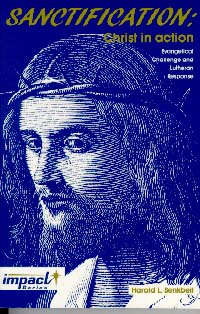
Book Review/Summary - Sanctification (Harold Senkbeil)


This book was good, but was more about the American Evangelical movement than sanctification as a theological topic.

One major topic was the confusion between the left and the right hand kingdoms. Senkbeil states, "Whenever the church has allied itself too closely with the cultural establishment, it has become corrupt and its Gospel has been secularized." He then points out that

  1. Liberals try to make the secular sacred by adopting societal ethics and norms
  2. Evangelicals try to makes the sacred secular by promoting "Christian" music, books, money management, etc..

Modern Evangelicalism is not really a theological system, but more of a mood, a perspective, and an experience. It focuses on a personal decision in conversion, while putting a spotlight on human experience instead of God's action.  However, the link between God and believer should never be our feelings but the person and work of Jesus Christ, who comes to us in his Gospel, not in our hearts. They teach that the wrath of God poured out on Jesus, so we receive God's Mercy, but then Grace comes from the individuals sanctified will and works. Thus we are partly forgiven because of our decision. Evangelicalism is:

  1. more form than substance
  2. more style than content
  3. more mind-set than dogma
  4. teaching replaced by lifestyle

It also picked the "selfish" or individualistic pieces of different traditions:

  1. Calvinism: individualism, but destiny
  2. Revival Arminisanism: Free Will in Conversion
  3. European pietist: spirituality and obedience
  4. Modernists: Focus on human achievement. more interested in that than Gods salvation

Most of their teaching revolves around "sanctification" as they call it, which is really "Christian" self help, a practical/pragmatic religion. In this system of thought Biblical figures, including Christ, become examples for us, instead of the story of how God saves us.

Friday, September 4, 2015

10 Commandments in the New Testament


Since they are from the old covenant, are they still valid? Absolutely. They still guide us in our life, both as individual Christians, and in civil society, and they still show us how we fall short of every one of them and so need the Grace of God.

 Old TestamentNew Testament
First
Commandment
Exodus 20:3;
Deuteronomy 5:7
Matthew 4:10; Luke 4:8; Revelation 14:7
Second
Commandment
Exodus 20:4-6;
Deuteronomy 5:8-10
Acts 15:20; 1 Corinthians 6:9-10; Galatians 5:19-20; Ephesians 5:5
Third
Commandment
Exodus 20:7;
Deuteronomy 5:11
Matthew 5:33-37; 1 Timothy 6:1; James 2:7
Fourth
Commandment
Exodus 20:8-11;
Deuteronomy 5:12-15
Luke 4:16; 23:55-56; Acts 17:1-2; 18:4; Hebrews 4:9; 1 John 2:6
Fifth
Commandment
Exodus 20:12;
Deuteronomy 5:16
Matthew 15:4-9; 19:19; Mark 10:19; Luke 18:20; Romans 1:29-30; Ephesians 6:1-3
Sixth
Commandment
Exodus 20:13;
Deuteronomy 5: 17
Matthew 5:21-22; 19:18; Mark 10:19; Luke 18:20; Romans 1:29-30; 13:9
Seventh
Commandment
Exodus 20:14;
Deuteronomy 5:18
Matthew 5:27-28; 19:18; Mark 10:11-12, 19; Luke 16:18; 18:20; Romans 7:2-3; 13:9
Eighth
Commandment
Exodus 20:15;
Deuteronomy 5:19
Matthew 19:18; Mark 10:19; Luke 18:20; Romans 13:9; Ephesians 4:28; 1 Peter 4:15; Revelation 9:21
Ninth
Commandment
Exodus 20:16;
Deuteronomy 5:20
Matthew 19:18; Mark 10:19; Luke 18:20; Acts 5:3-4; Romans 13:9; Ephesians 4:25
10th
Commandment
Exodus 20:17;
Deuteronomy 5:21
Luke 12:15; Romans 1:29; 7:7; 13:9; 1 Corinthians 6:9-10; Galatians 5:19-21; Ephesians 5:3, 5


Tuesday, September 1, 2015

It's Bigger on the Inside


G.K. Chesterton (29 May 1874 – 14 June 1936) was a prolific English, Roman Catholic writer and Christian apologist.  Chesterton's 1925 The Everlasting Man was a sort of rebuttal to a sort of rebuttal to H.G. Wells’ 1920 Outline of History. The The Everlasting Man contributed to C. S. Lewis's conversion to Christianity. In a letter to Sheldon Vanauken (14 December 1950) Lewis calls the book "the best popular apologetic I know",  and to Rhonda Bodle he wrote (31 December 1947)  "the [very] best popular defence of the full Christian position I know is GK Chesterton's The Everlasting Man". The book was also cited in a list of 10 books that "most shaped his vocational attitude and philosophy of life". It also influenced Lewis to write apologetically, as in Mere Christianity. In fact, many of Lewis' motifs are derived from English authors who had just preceded him, such as the spacecraft in his 1938 Out Of The Silent Planet being losely modeled on the one in H.G. Wells' 1901, The First Men In The Moon.


In 1927, five years after his conversion, Chesterton wrote The Catholic Church and Conversion. Lewis could relate to this having been a convert himself. In this book, he states that a convert, upon discovering that the Catholic Church “finds that the Church is much larger inside than it is outside.” It logically follows that C.S. Lewis could have taken this for inspiration in his later book. Lewis completed the last ‘Narnia’ story, The Last Battle, in 1953, in which we see the end of the world of Narnia. At one point in the story the children find themselves in a stable. Seen from the outside it looked small and dingy, but when they go through the door they find themselves in a beautiful country that seems to stretch on forever. Someone comments that the stable is bigger on the inside than it is on the outside. The reply in the book is, “Yes,” said Queen Lucy. “In our world too, a Stable once had something inside it that was bigger than our whole world.”

Lewis’ stable is also connected with a kind of time travel, as it brought characters from the Narnia’s ancient past (indeed Digory watched its first dawn) into its last days. It is conceivable that Lewis' time traveling stable that is bigger on the inside could have been the inspiration for the time traveling Police box in Doctor Who known as the TARDIS. The Last Battle was a recent book when the TARDIS was first shown in Doctor Who in 1963. Lewis died the day before the first episode was shown, so he never got to comment.