Tuesday, December 4, 2018

John of Damascus


John of Damascus (c.676 - Dec 4, 749), was the last of the Church Fathers. He was known for his contributions to theology, but also to law, philosophy, and music. He also defended the use of icons against the iconoclasts.
Sola Scriptura


Sola Gratia


Sunday, December 2, 2018

Advent 1 - Hope (New Church Year)

Today is the first Sunday of Advent, which is the first day of the new church year. It occurs four Sundays before Christmas (December 25). Advent lasts between 22 and 28 days depending on the day of the week Christmas falls. Advent is the preparatory season where we get ready for Christ to come into the world. The first Sunday is focused on the hope that came from the Old Testament prophecies about the coming Messiah.


  • 1st CANDLE – THE PROPHECY CANDLE or CANDLE OF HOPE – We can have hope because God is faithful and will keep the promises made to us. Our hope comes from God. “And again, Isaiah says, ‘The Root of Jesse will spring up, one who will arise to rule over the nations; the Gentiles will hope in him.’ May the God of hope fill you with all joy and peace as you trust in him, so that you may overflow with hope by the power of the Holy Spirit.” (Romans 15:12-13)

Zechariah 9:9–10 and Matthew 21:1–9 are always read in the service from the Lectionary, and the symbolism of the day is that Christ enters the church.

Today is also the beginning of Chanukah, the festival of lights, which I will discuss in a future post. Modern people associate it as the Jewish Christmas, but only because it is during the same time of year and involved lighting candles.

Sunday, November 18, 2018

Book Review/Summary - Ordering Our Days in His Peace (Heath Curtis)


This is a great book about the Church year!
  • God made everything for the good of humanity.
  • God made time.
  • Time is for the good of humanity because it helps us make sense of and order God's creation.
  • The Gospel is a story that takes place through time.
  • The Church uses the church year calendar to keep time and tell the Gospel.
  • Each part of the church year has something new to give us and a piece of the story to tell.
    • The time of Christmas is about our Savior being promised and finally coming
    • The time of Easter is the fulfillment of the Savior's work
    • The time of the Church is about God working through the Church after the Savior comes
  • God works through the church by the means of the Word and Sacraments.
  • The Church year and Gospel are ordered through the Divine Service.
  • The Divine service is ordered to give us all of the gifts God wants to give us (the Word and Sacraments)

Sunday, November 4, 2018

The Sabbath

The Sabbath

The word Sabbath comes from the Latin sabbatum, via Greek from Hebrew šabbāṯ. The Sabboth day is the first holiday (Holy Day) mentioned in the Bible:

God created the universe and everything in it in six days and rested on the seventh, declaring it to be holy (Gen. 2:3).

When the Hebrews wandered in the desert, they were to collect manna on six days. On the sixth day they were to collect enough for the seventh day. Each evening the manna that not had been consumed rotted by morning, except the manna collected on the sixth day. It was good on the seventh (Ex. 16:14-31)

When He gave Moses the Law, God made remembering and observing the Sabbath the fourth commandment. (Ex. 20:8).

“Six days shall work be done, but on the seventh day is a Sabbath of solemn rest, a holy convocation. You shall do no work. It is a Sabbath to the Lord in all your dwelling -Leviticus 23:3

Throughout the Old Testament God’s people are admonished to do no work and to rest on the Sabbath, to remember all that God has done for them.

Yet, when questioned by the Pharisees why He allowed his men to pick grain enough to eat on the Sabbath, Jesus replied that the Sabbath was made for man, not man made for the Sabbath (Mark 2:23-27)  Although Jesus allowed His men to pick the food they needed on the Sabbath, He did not negate or change the need for or meaning of the Sabbath.

After Jesus was raised from the dead on Sunday, the Christian Church largely changed the Sabbath observance to Sunday. Now each Sabbath is a mini-Easter celebration.

Sunday, October 21, 2018

Days of the week

Days of the Week

Sunday
The name comes from the Latin dies solis, meaning "sun's day": the name of a pagan Roman holiday. It is also called Dominica (Latin), the Day of God, since Jesus was raised on Sunday. Being the first day, it is also the eighth day, which represents new creation. After Jesus, the Church celbrates the Sabboth on Sunday. The Romance languages, languages derived from the ancient Latin language (such as French, Spanish, and Italian), retain the root.
French: dimanche; Italian: domenica; Spanish: domingo
German: Sonntag; Dutch: zondag. [both: 'sun-day]

Monday

The name comes from the Anglo-Saxon monandaeg, "the moon's day". This second day was sacred to the goddess of the moon.
French: lundi; Italian: lunedi. Spanish: lunes. [from Luna, "Moon"]
German: Montag; Dutch: maandag. [both: 'moon-day']

Tuesday
This day was named after the Norse god Tyr. The Romans named this day after their war-god Mars: dies Martis.
French: mardi; Italian: martedi; Spanish: martes.
The Germans call Dienstag (meaning "Assembly Day"), in The Netherlands it is known as dinsdag, in Danmark as tirsdag and in Sweden tisdag.

Wednesday
The day named to honor Wodan (Odin).
The Romans called it dies Mercurii, after their god Mercury.
French: mercredi; Italian: mercoledi; Spanish: miércoles.
German: Mittwoch; Dutch: woensdag.

Thursday

The day named after the Norse god Thor. In the Norse languages this day is called Torsdag.
The Romans named this day dies Jovis ("Jove's Day"), after Jove orJupiter, their most important god.
French: jeudi; Italian: giovedi; Spanish: jueves.
German: Donnerstag; Dutch: donderdag.

FridayThe day in honor of the Norse goddess Frigg.
In Old High German this day was called frigedag.
To the Romans this day was sacred to the goddess Venus, and was known as dies veneris.
French: vendredi; Italian: venerdi; Spanish: viernes.
German: Freitag ; Dutch: vrijdag.


Saturday
This day was called dies Saturni, "Saturn's Day", by the ancient Romans in honor of Saturn. It was the Sabbath day before Jesus' resurrection because the Church rested on the Seventh Day as God did during creation.
French: samedi; Italian: sabato; Spanish: sábádo.
German: Samstag; Dutch: zaterdag.

Sunday, October 7, 2018

Names of the months

Origin of the names of the months
Only a few names of the month were derived from Roman deities. Most simply came from the numbers of the months, or in two cases in honor of Roman emperors.

January
Named after the Roman god of beginnings and endings Janus (the month Januarius).

February
The name comes either from the old-Italian god Februus or else from the word februa, signifying the festivals of purification celebrated in Rome during this month.

March
This is the first month of the Roman year. It is named after the Roman god of war, Mars.

April
Called Aprilis, from aperire, "to open". Possible because it is the month in which the buds begin to open.

May
The third month of the Roman calendar. The name probably comes from Maiesta, the Roman goddess of honor and reverence.

June
The fourth month was named in honor of Juno. However, the name might also come from iuniores (young men; juniors) as opposed to maiores (grown men; majors) for May, the two months being dedicated to young and old men.

July
It was the month in which Julius Caesar was born, and named Julius in his honor in 44 BCE, the year of his assassination. Also called Quintilis in Rome (fifth month).

August
Originally this month was called Sextilis (from sextus, "six"), but the name was later changed in honor of the first of the Roman emperors, Augustus (because several fortunate events of his life occurred during this month).

September
The name comes from septem, "seven".

October
The name comes from octo, "eight"

November
The name comes from novem, "nine".

December
The name comes from decem, "ten".

Saturday, September 22, 2018

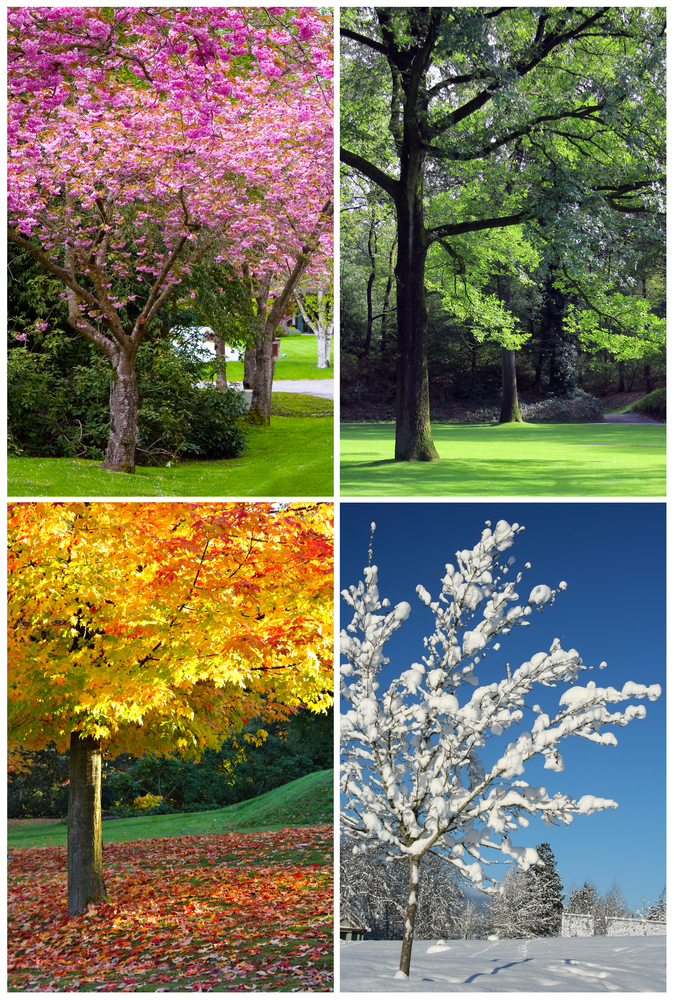
Seasons

seasons
Since today is the Autumnal Equinox, I thought I would have a post on the seasons. Genesis 1:14 states that God made the seasons, "And God said, “Let there be lights in the expanse of the heavens to separate the day from the night. And let them be for signs and for seasons, and for days and years". Ecclesiastes 3:1 states, "For everything there is a season, and a time for every matter under heaven"
The name of “Autumn” came to English via the Old French “autompne”, meaning "autumn".  This in turn came from the Latin “autumnus”, also meaning “autumn”.  From here things get murky, but it’s thought “autumnus” probably came from an Etruscan word and is possibly related to the Latin “augere” meaning “to increase”.  Beyond that, nobody is quite sure why the season was originally called that.
Calling the season “autumn” in English first popped up in the 12th century, though was a rarity until around the 14th century.  It then began to pick up steam and became common in the 16th century, about the same time calling it “fall” popped up as the name for the season.  Before calling the season “autumn” or “fall” in English, it was called “harvest”.

The origin of the alternate “fall” as a name for this season  is not actually known, although it’s thought that it probably came from the idea of leaves falling from trees. Maybe even as a shortening of the English saying “fall of the leaf”.  Its first use as a name for the season was in the later 16th century in England and became particularly popular during the 17th century, at which point it made its way over to North America.
Funny enough, calling autumn “fall” in England has since passed out of widespread practice, but has survived as a common name for the season in North America.   This is not unlike how “soccer” was originally one of the most popular names for the sport in England around its inception and a long time after, which spread to North America, only to have the name die out in England, leading many to believe “soccer” is an “American” name for the sport, rather than one of the original names for it in England.
“Winter” derives from the Proto-Germanic wentruz, meaning "winter".  This in turn probably comes from the Proto-Indo-European (PIE) wed, meaning “wet”.  Alternatively, it may come from the PIE wind-, meaning “white”.  Either way, the Proto-Germanic wentruz gave rise to the Old English “winter” as the fourth season of the year and the name for the season has stuck around ever since.
“Spring”, referring to a season rather than the many other meanings of the word, first popped up in the 16th century.  Starting in the 14th century, this time of year was called “springing time” and then in the 15th century this got shortened to “spring-time”, and then further shortened in the 16th century to just “spring”.  The 14th century “springing time” came about in reference to plants “springing” from the ground and the like.  Before the season was called these things, it was called “Lent” in Old English.
“Summer” came from the Old English name for the season “sumor”, which in turn came from the Proto-Germanic sumur-, which itself came from the Proto-Indo-European root sam-, meaning summer. sam- seems to be a variant of the Proto-Indo-European sem- meaning “together / one”.
Incidentally, you may also wonder why the seasons are called “seasons”.  The word “season” in this context comes from the Old French “seison”, meaning “sowing / planting”.  This in turn came from the Latin “sationem” meaning “sowing”. Initially this referred to actually sowing seeds, but later, as with the Old French “seison”, shifted definition to refer to the time period when you sow seeds, so literally “seed-time”.  “Season” in this sense in English popped up around the 13th century.  It was also around this time that “season” popped up referring to seasoning food- in this case from the Old French “assaisoner”, meaning “to ripen”.